Culture is a system. We treat it like one.
Most culture work treats culture as a mood to be managed. We treat it as your organizational operating system: the shared purpose, behaviors, and conditions that determine whether your strategy runs or stalls. A system can be measured, designed, and evolved on purpose. That is what the Culture Design method does, across six dimensions and four stages, with the rigor a serious transformation deserves.
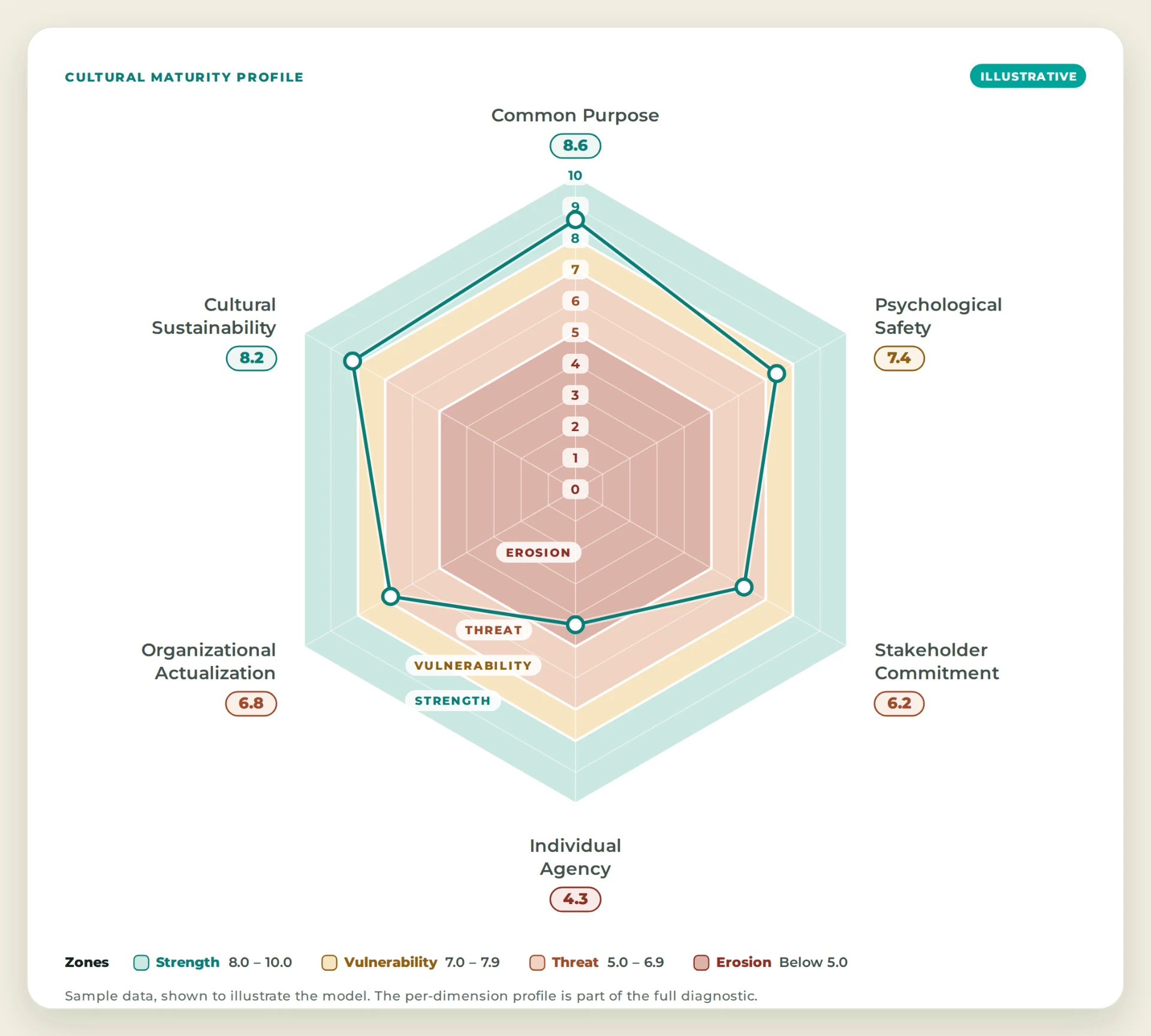
Six dimensions determine whether your culture can carry your strategy.
Sentiment tells you how people feel. It does not tell you whether the culture can deliver. The Cultural Maturity Assessment measures six dimensions that, together, describe your culture's capacity to turn intention into outcome. Each is scored on its own, so you see exactly where you are strong and where you are vulnerable.
- 01
Common Purpose
Whether the organization shares a clear vision, mission, and set of principles, and whether people understand how to deliver on them in their own roles. Purpose that lives in a deck is not purpose; this measures whether it actually drives decisions and behavior.
- 02
Psychological Safety
Whether people trust their leaders and each other, feel respected, and can speak up, challenge, and experiment without fear. It is the condition that makes every other dimension possible.
- 03
Stakeholder Commitment
Whether leaders and employees are genuinely invested in the culture and the strategy it serves, from leadership prioritizing the employee experience to people's pride, retention, and willingness to back new direction.
- 04
Individual Agency
Whether people are empowered, included, and free to contribute their best: supported with the tools to act, trusted with real decisions, and welcomed for the diversity of thought they bring.
- 05
Organizational Actualization
Whether the organization can actually execute: communicating openly, collaborating across functions instead of in silos, and turning strategy into coordinated action.
- 06
Cultural Sustainability
Whether the culture can adapt, absorb change, and hold its strengths over time, so that a change in leadership, strategy, or market conditions does not undo it.
How your results read
Each dimension is scored and placed in one of four zones, so the headline is what the score means, not just the number. It is the same topographical model behind the AI-Readiness Assessment, so the two read consistently.
- Strength
An asset to build on.
- Vulnerability
Fragile, worth shoring up.
- Threat
A likely barrier.
- Erosion
Needs immediate attention.
See where you stand. Take the complimentary Cultural Maturity Assessment →
Diagnose it. Design it. Roll it out. Keep it evolving.
Measurement is the start, not the answer. The Culture Design method carries an organization through four stages, from seeing the culture clearly to sustaining a stronger one. You can enter at any stage, and you keep ownership of the work throughout.
- 01 · DISCOVER
Discover
See the culture you actually have. We assess the six dimensions, surface the root drivers behind the scores, and locate the gaps between the culture you have and the strategy you are running. The output is a cultural maturity profile you can act on.
- 02 · DESIGN
Design
Blueprint the culture your strategy needs. We translate the diagnosis into a target operating culture, the purpose and principles that anchor it, the governance and decision rights that support it, and the behaviors that bring it to life.
- 03 · DIFFUSE
Diffuse
Roll it out without losing fidelity. We help you cascade the design through leaders and teams, with the planning, enablement, and communication that turn intent into everyday practice.
- 04 · DEVELOP
Develop
Keep it evolving. We reassess, track how the culture is moving across the six dimensions, and course-correct, so culture becomes something you steer rather than something that happens to you.
Rigor where culture work usually relies on instinct.
We measure capacity, not mood.
Engagement scores tell you people are unhappy. Our six dimensions tell you whether the culture can carry new strategy, technology, or growth, and which part is at risk. That is a difference you can act on.
We start with purpose.
Purpose is the organizing force of a healthy culture, not a tagline. The method designs culture outward from why the organization exists and the outcomes it exists to create.
We design the whole system.
Culture is shaped by leadership, principles, governance, decision rights, communication, and behavior together. We work the system, not a single lever, because pulling one in isolation is how well-intentioned change stalls.
We build for handoff, not dependency.
The method is designed so your organization owns the culture and can sustain it. Governance and capability are built to outlast the engagement, not to keep the advisor in the room.
AI adoption is a culture problem before it is a technology problem.
Every organization is being told to adopt AI. Most treat it as a technology rollout, then are surprised when it stalls. The tools are rarely the constraint. Whether people trust how decisions get made, whether they are safe to experiment, whether leadership has built the conditions for new ways of working: that is what determines whether AI takes hold or is quietly resisted. AI runs on your culture, the same operating system everything else runs on.
Because that question is specific and urgent, Culture Design offers a dedicated AI-Readiness Assessment: a separate, focused assessment with its own dimensions, built to measure whether your organization can adopt AI well. The Cultural Maturity Assessment is the complimentary way in and gives you the whole picture of your culture; the AI-Readiness Assessment is a guided diagnostic, the specialized lens for organizations actively adopting AI. If AI is the pressure testing your culture right now, that is where to start.
The same method, at the depth your challenge calls for.
The method is not a fixed package. A strategy session applies it to one live challenge. A diagnostic runs the Discover stage in full. Facilitated workshops move a team through Design and Diffuse. An advisory partnership runs the whole arc and stays for Develop. Wherever you start, the six dimensions and the four stages are the through line.
Put the method to work on your culture.
Start with the complimentary Cultural Maturity Assessment, or get started and let's work together to solve your greatest cultural challenges.